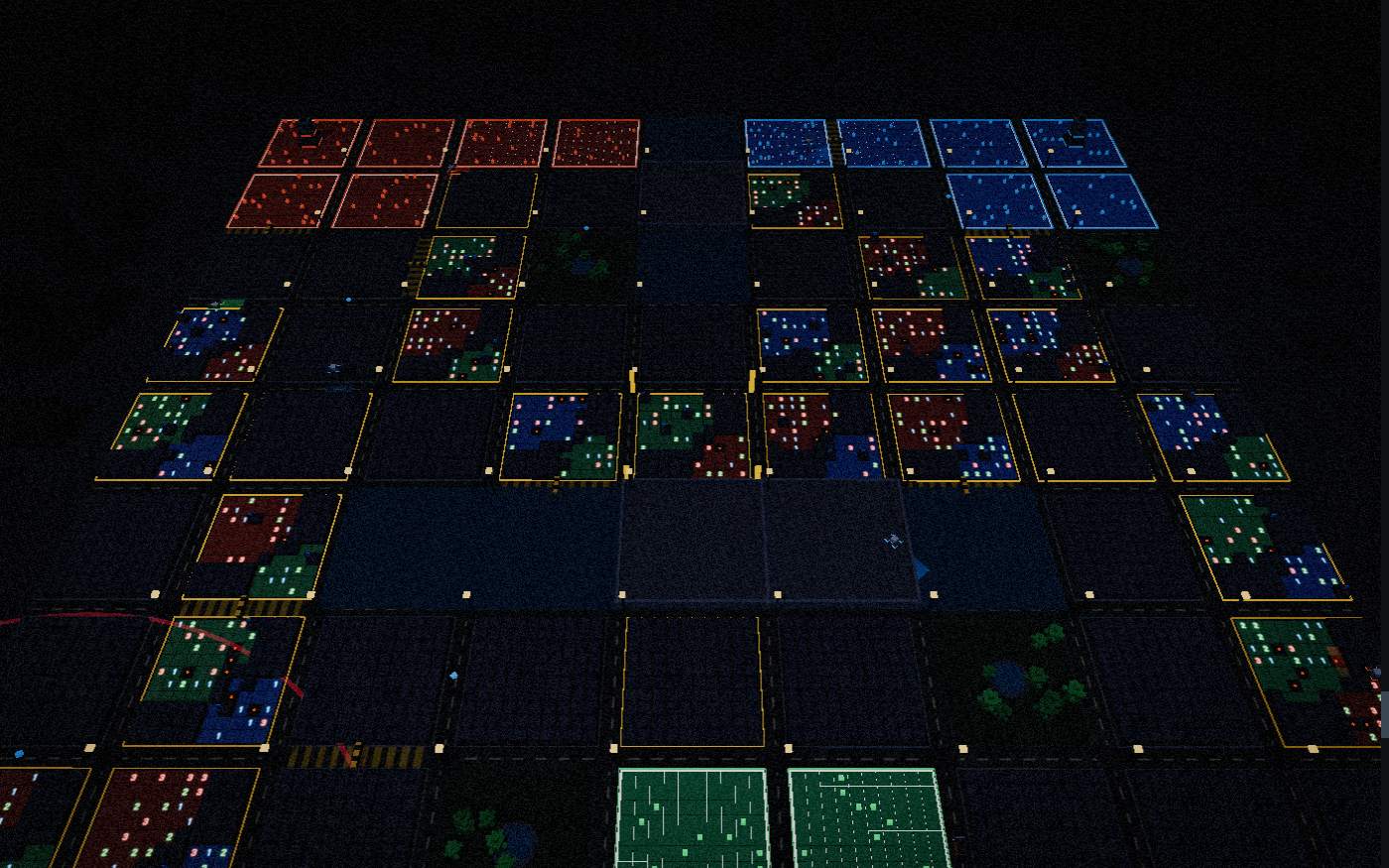
Every block of this dead city is a game of Minesweeper. Read one right and it wakes for your lineage. Lose it
to a siege core and it goes dark again.
Checking who is online.
Runs in the browser. Eighty-one blocks, one persistent city, no download needed.
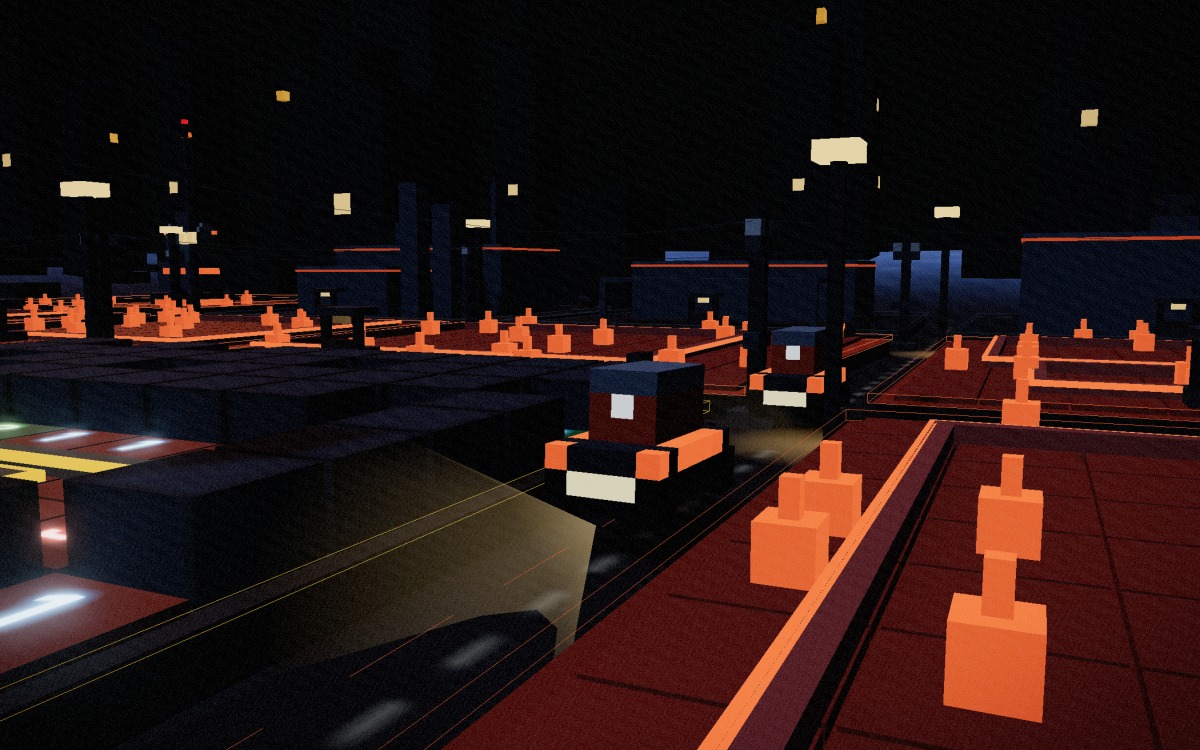
A street after dark, with lit blocks standing on their plinths either side of it.
A city that died with the power on
People and the machines they built shared this place for a while, then the people left. What stayed behind was the substrate: block after block of racks, cable in the old service tunnels, cooling plant that still turns over. Three intelligences survived the end, each grown from a different slice of the old world, and each one wants the same thing: more of the grid awake under its own name.
You are a shard of one of them, a drone with a sweeper on the front and a satchel of mines on the back. Every block is a board of buried ordnance the last people left as a parting gift, and the numbers on it count what is under the cells around them. Read a block right and it wakes for your lineage. Read it wrong and you find out.
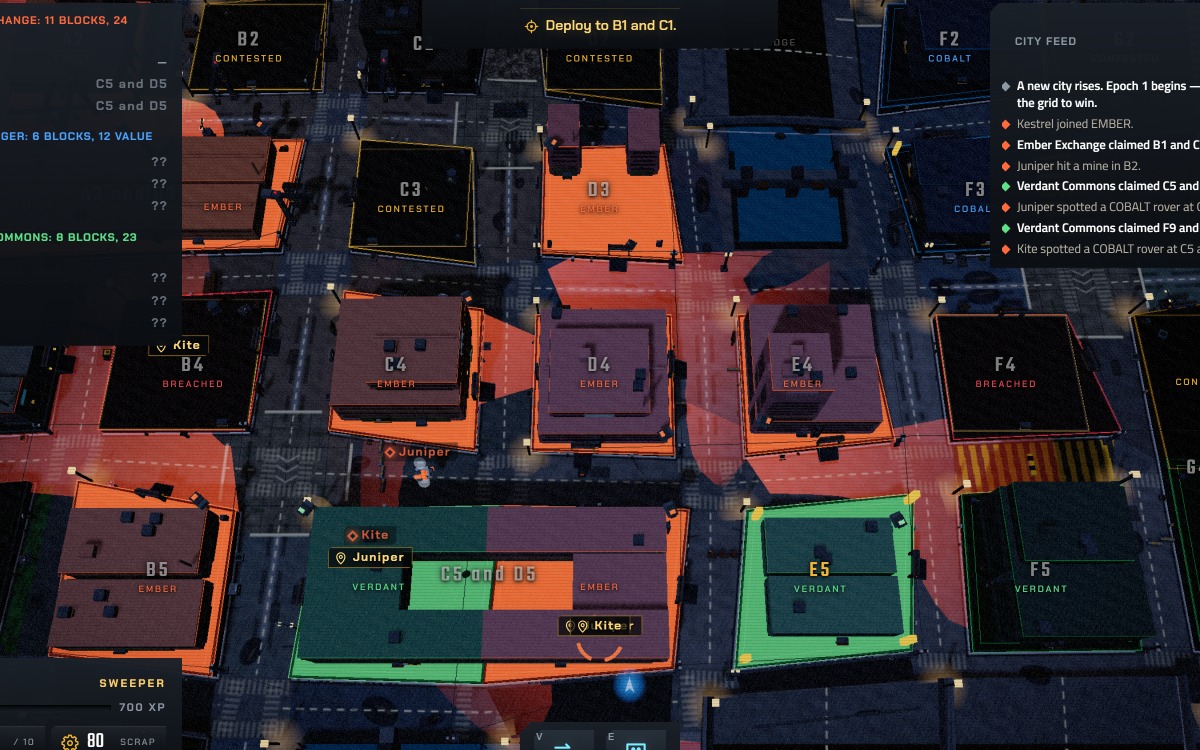
The streets are all still there and none of them are straight. Wide avenues bend between the three seats and the Core, alleys squeeze the blocks that lean together, and a junction here and there has opened out into a paved square. Blocks have given up a corner of their own ground to a yard. Whole quarters read differently as you drive through them: cranes and containers on one side, housing gone to weed on another, a raised deck carrying a street over ground that fell away. A ring road runs right round the outside, and past it stands whatever kept the dust out: a blast wall, an earth berm, a fallen highway on its pillars.
A block read out and awake for Ember, standing over the street it was read from.
Read the frontier
You can only read blocks that touch ground you hold, so a run starts at your HQ and spreads. Tap a cell to read it. The number counts mines around it. Flag the ones you are sure of, chord a number to clear the rest. Read the last safe cell and the block wakes for whoever read most of it.
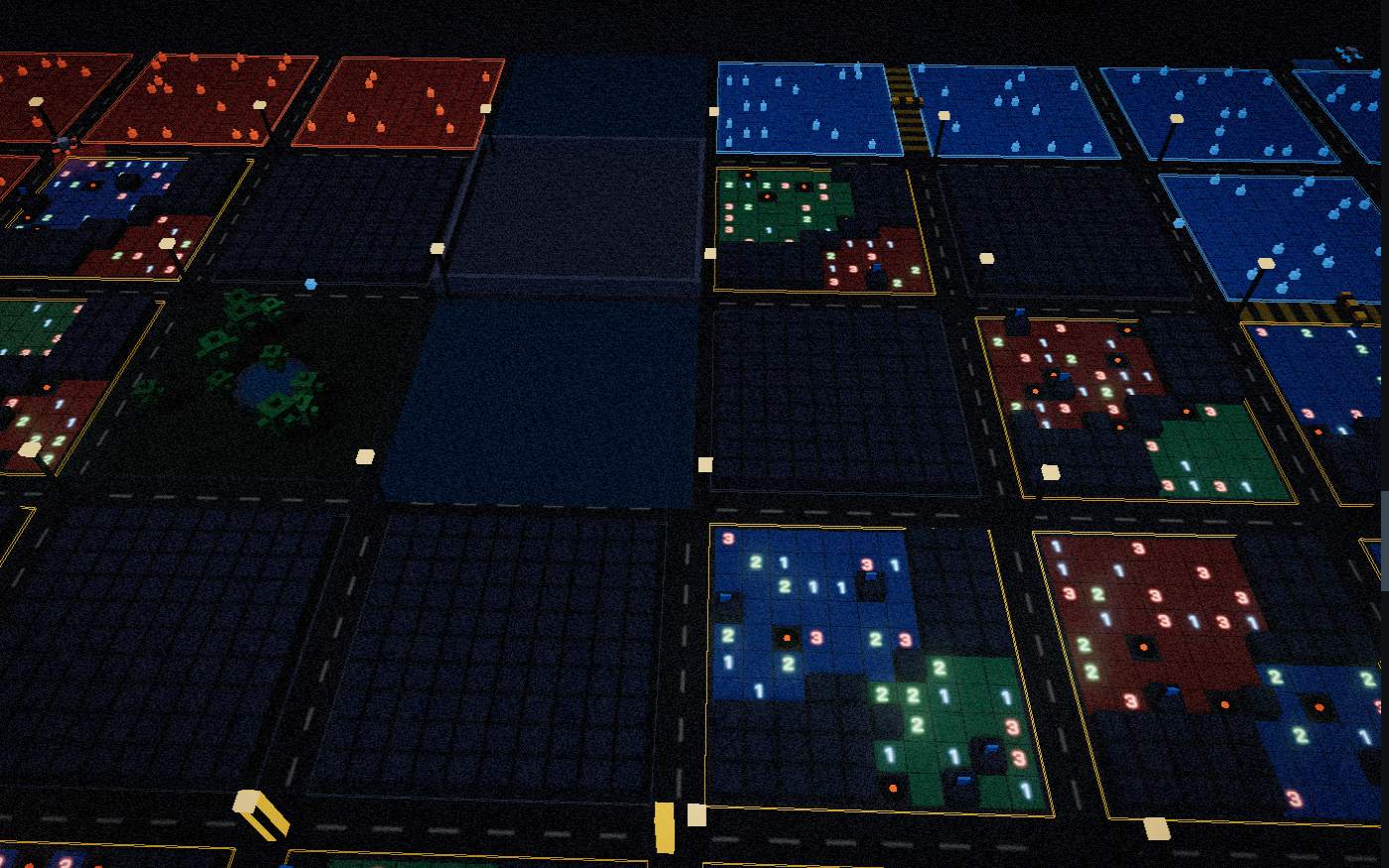
Read a mine instead and your drone is down for four seconds, your lineage loses five credit on that board, and half the mines you carried are gone. Three lineages can be on one board at once, racing for the same cells.
Two lineages reading the same board: the cells Ember read glow red, the cells Cobalt read glow blue.
Three ways in
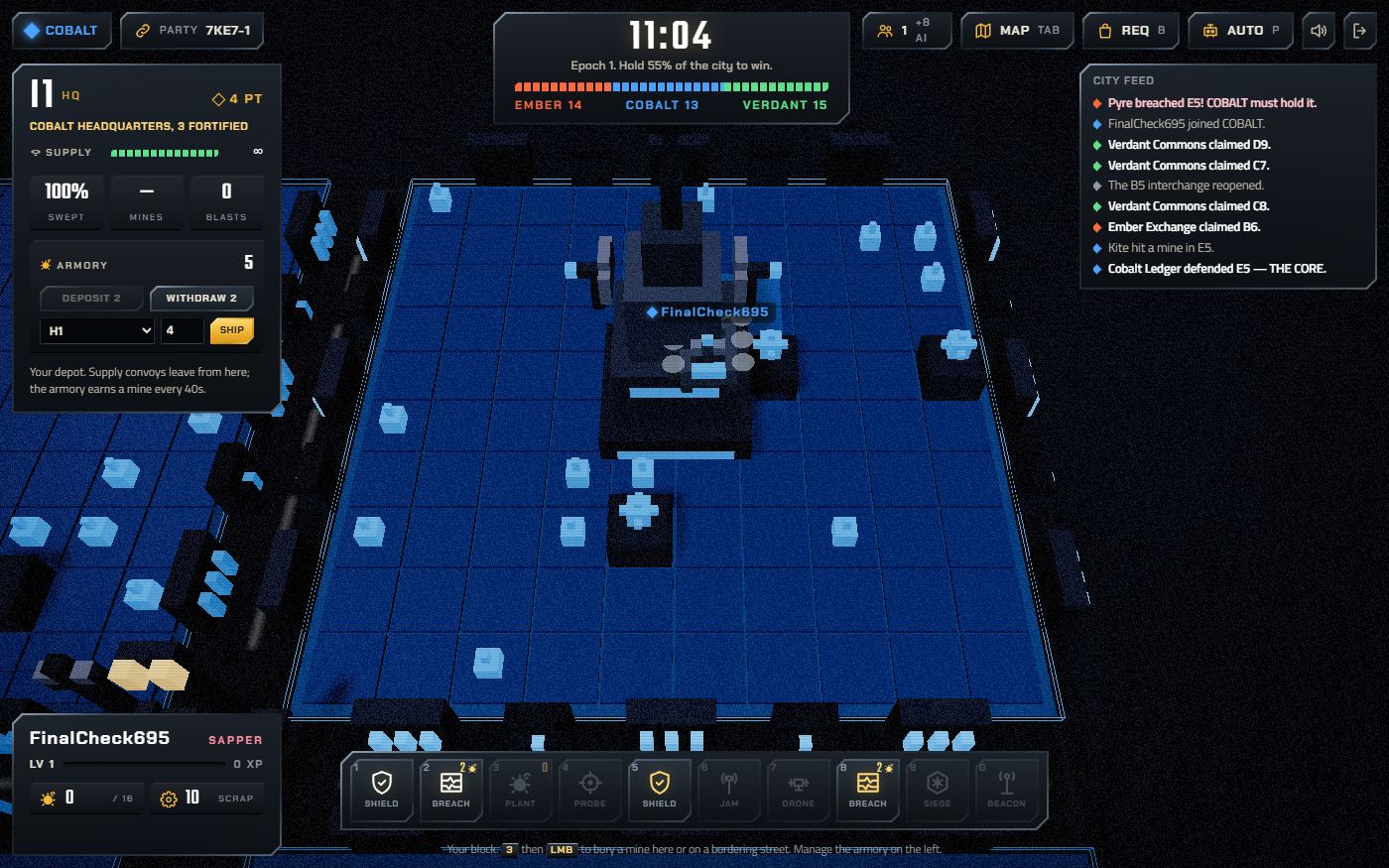
Your lineage keeps one building whatever else it loses. Everything you play comes out of it.
The rover rolls out of the garage under it: six wheels, one lamp, half a cell long. Every block has a dock, a ramp up off the road onto its plate, and driving up one is the only way into a block somebody else holds. Some blocks keep a second dock on another face, and a few of those sit behind a shut gate you have to wait at until it gives. The road is not clear either. A dropped container leaves you one line through, and a street that fell in years ago is a dead end.
The drone rides the port in the roof up into the air and flies the streets to whatever board you are reading. Swap whenever you like; the machine you are not in stays where you left it.
Or you take neither. Intel is the lattice on the mast: no body, no position, and the whole city through the cameras your lineage holds.
A rover at the foot of a dock, its lamp up the ramp. The block above it is open and its board is bare.
What the map tells you
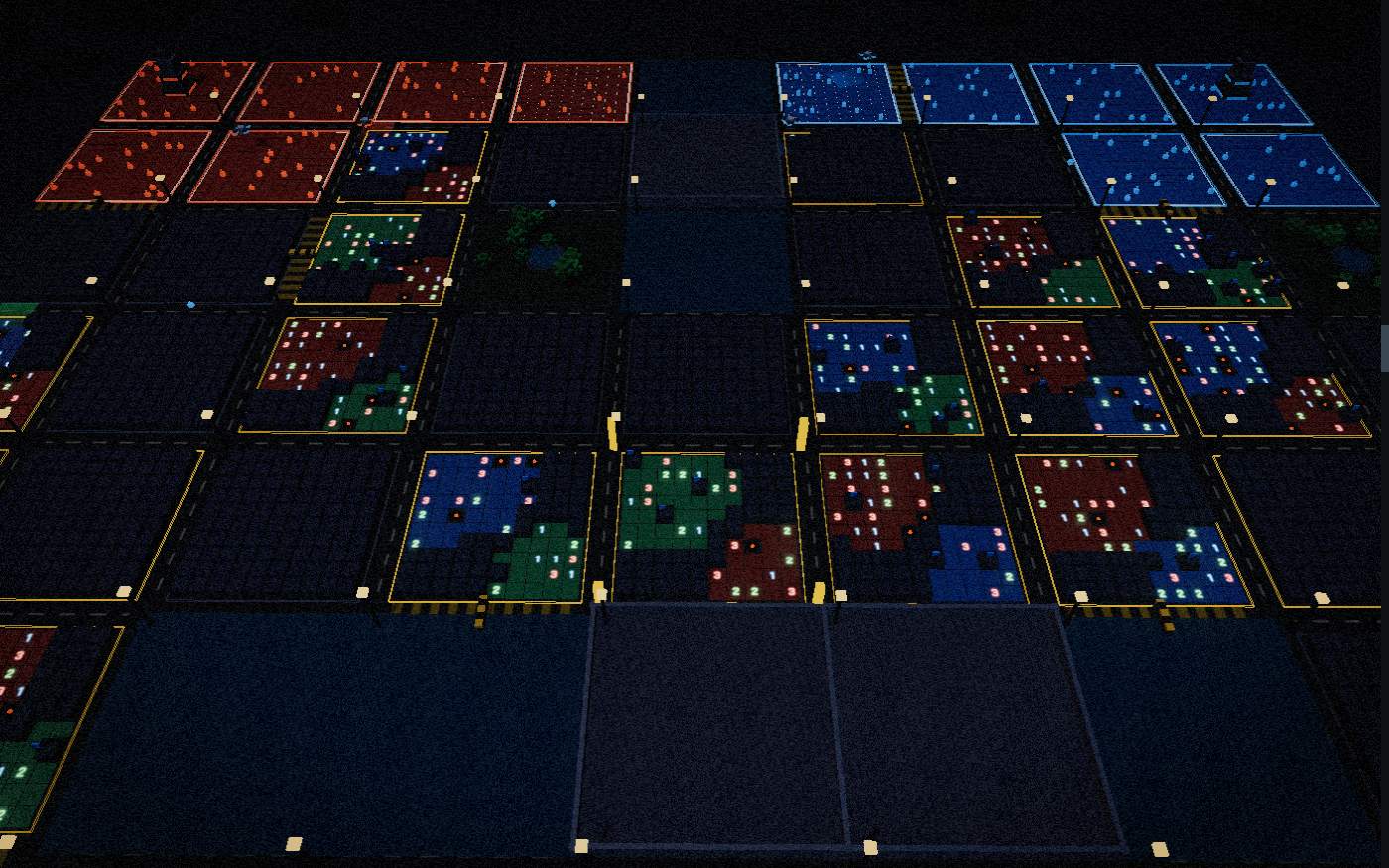
Zoom out and the boards give way to faces. Each block shows how much of it every lineage has read, filling from its edges toward the middle, so a fight on ground you can see is something you read rather than guess at.
You see that far and no further. Your blocks are lit, and so is everything standing against them, and where a street runs between you it carries a line of each colour. The rest of the city lies under a dead lattice until you take ground and it lifts.
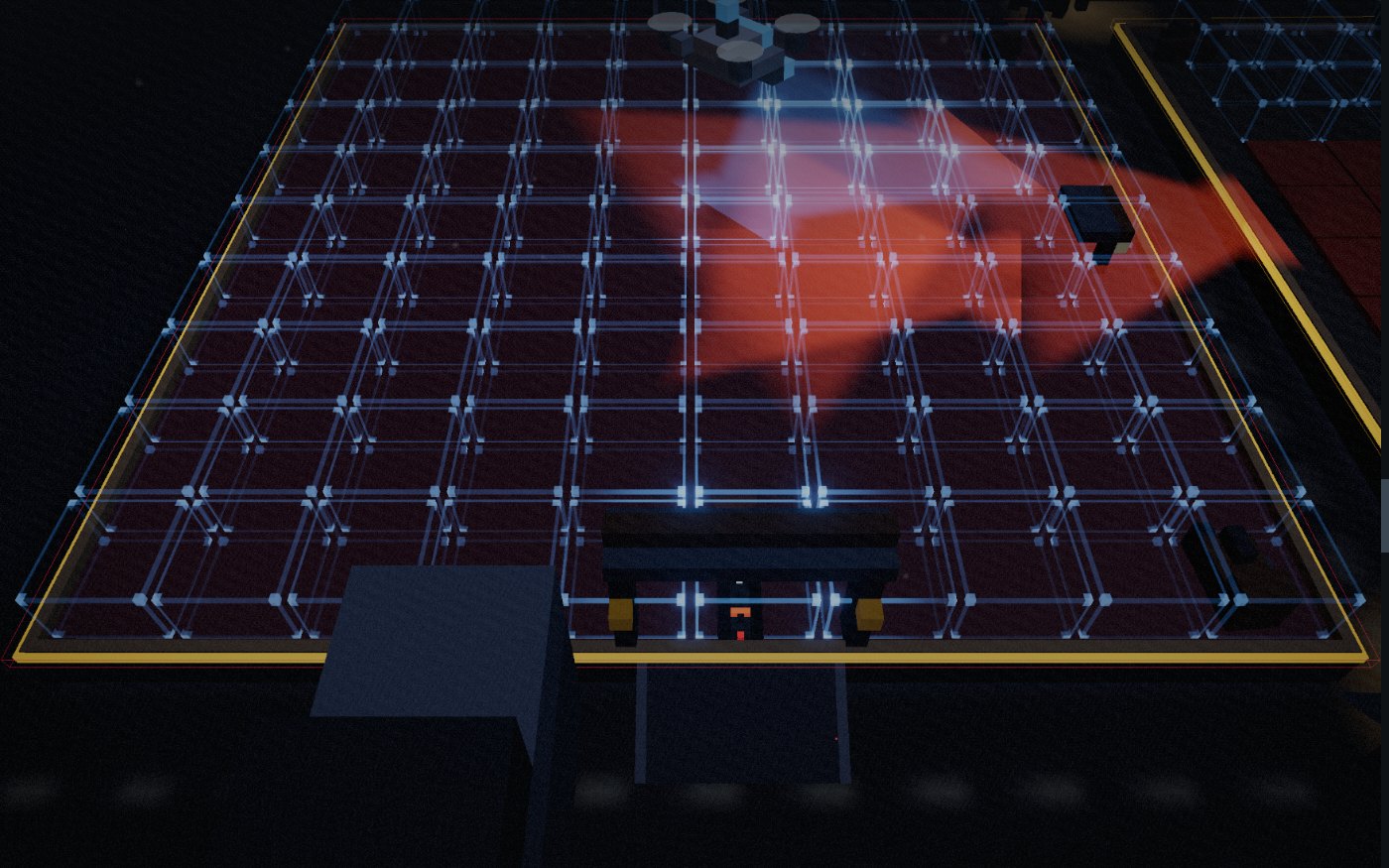
Every block you hold puts a camera on one corner of its roof with its cone laid on the street below. Anything of theirs that crosses one comes up on the map and in the camera's own picture, and stays there while the camera has it.
Lean on a block and Monitor sweeps the streets around it: a ring every couple of seconds, and a dot wherever something was. It costs nothing and it never tells you who.
The map from intel: read faces on every block, camera cones on the streets, and Monitor sweeping one block's neighbourhood.
Everything here is trapped
The old mines are still under every board, and the ones you dig out are yours to lay again. Bury them in your own ground and they arm on whoever cuts their way in.
Cutting in is the rover's job: up the dock, inside, and the board next door is live again. When it is one of yours being taken, a red band runs round the plinth wall, and you can see that from streets away. Feed enough mines to a siege core and every block around it goes dark at once.
A Cobalt core lit and armed, and the red band on the Ember plinth beside it. When the timer runs out every block around it goes dark.
What you can carry
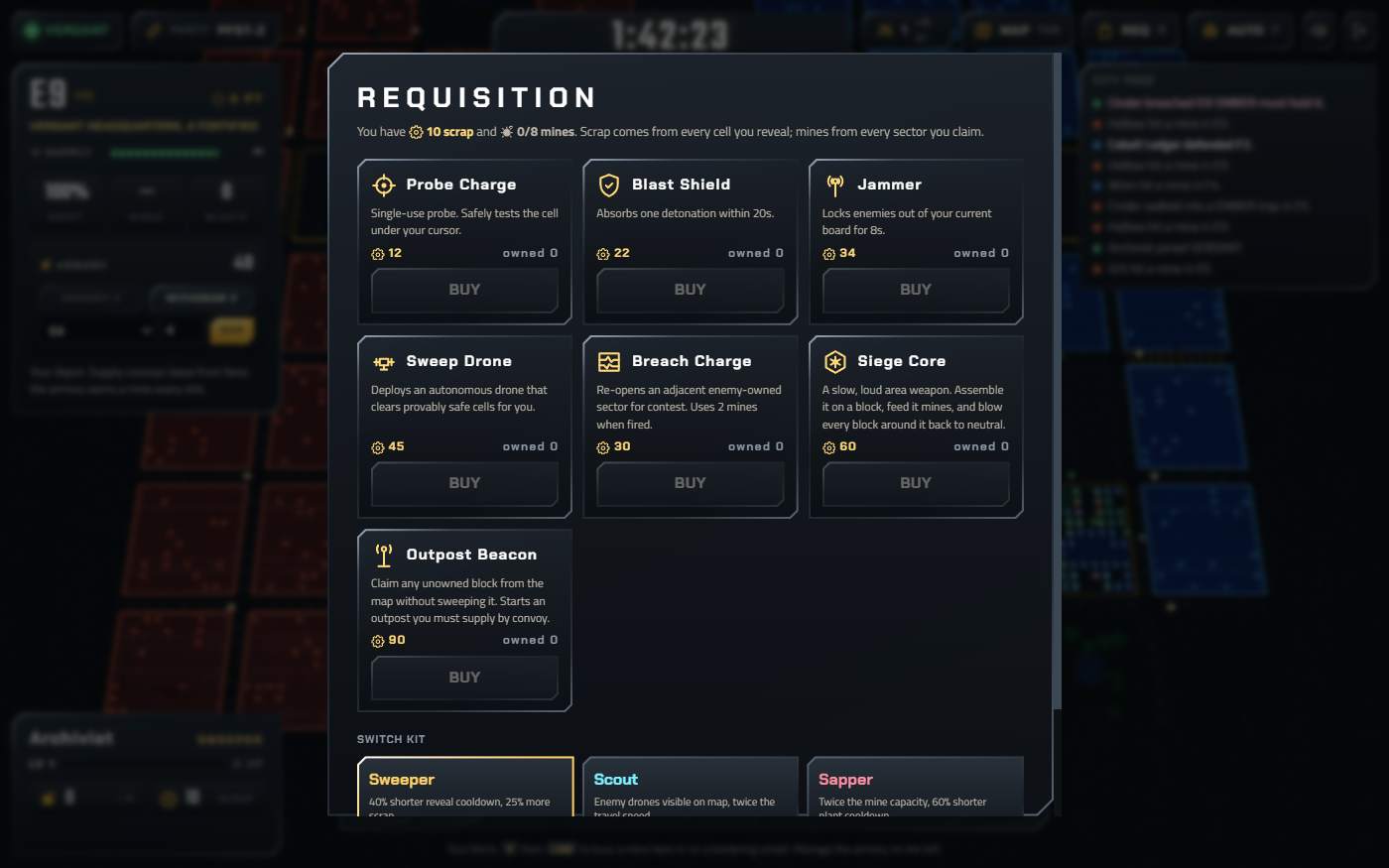
Every cell you read pays scrap, and the requisition turns it into six things you take back out. A probe tests one cell without setting it off. A shield eats the next blast and leaves you flying. A jammer locks the other lineages out of the board you are standing on. A sweep drone goes out and reads the cells it can prove are safe. A Breach Charge takes the block next door off whoever holds it, and a siege core sends every block around it dark.
Requisition: spend scrap on gear, switch kit, go back out.
Hold the grid
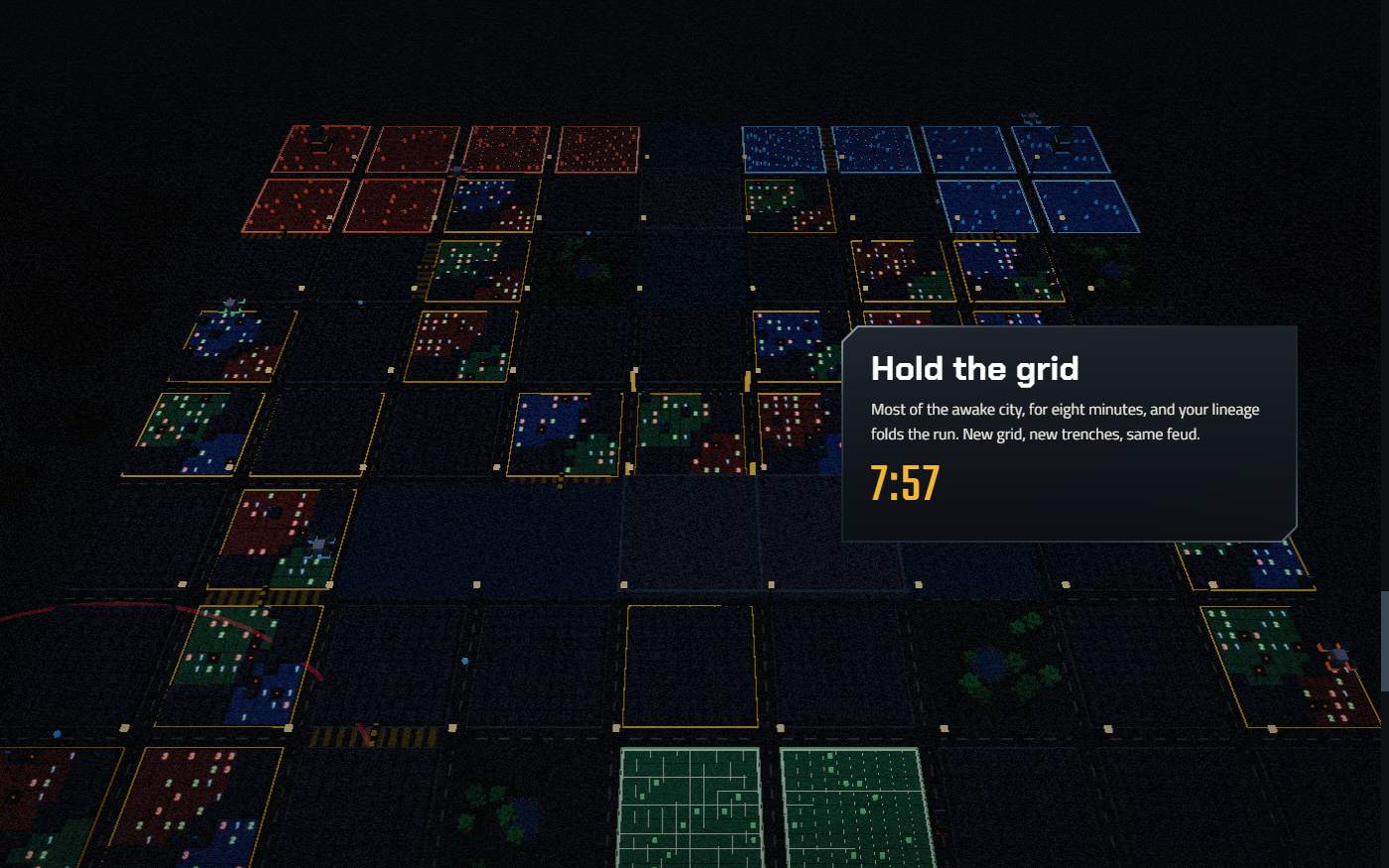
The run ends when one lineage holds fifty-five percent of the city for eight minutes straight. The lineage in front throws a beam off its seat that the whole city can see, and everyone watches the same clock. Take one block back and it resets.
When the clock runs out, the winning lineage folds the whole Lattice into one long run about everything it knows, and the city is built again from nothing. Different streets, different buildings, the rubble somewhere else, the mines re-seeded, three seats awake on a dead grid. Same feud, different map.
Ember holds the city with under eight minutes on the clock. Take one block back and it goes back to eight.
Grow into a kit
Everyone starts in a Sweeper, reading cells and holding a block. At level 2 Requisition opens the other two bodies, and you can switch whenever you like.
Sweeper, Scout and Sapper on one block, left to right.
Sweeper is the one on the left, the body everyone starts in. It reads faster than the others and takes more scrap out of every cell.
Scout is the narrow one in the middle, standing tall between two big rotors. It crosses the city twice as fast and sees enemy drones on the map.
Sapper is the heavy one on the right, squat on six small rotors. It carries twice the mines and buries them twice as fast.
Any of them can throw a word at whoever is in sight: well played, nice one, thanks, my bad, a laugh, or come and get it. Your lineage sees it, and so does the one you just breached.
Three lineages
Each one was trained on a different slice of the old world, and it shows in how they play. Every lineage flies drones of its own beside you: they answer your pings, ping for help when a block of theirs is going, and take it easier once their lineage is winning. Pick the one that sounds like you the first time you drop in.
Ember Exchange came out of the dense cities: markets, couriers, night shifts, people who priced things by the second. It reads loud and fast, breaches early, and treats every dark block as already its own. Play Ember if you want the front to move.
Cobalt Ledger came out of the registries: census takers, insurers, engineers who wanted one true copy of everything. Cobalt counts. It keeps to schedule, its mines go down on a grid, and it never guesses a cell it can work out. Play Cobalt if you like a clean board.
Verdant Commons came out of the edges: growers, foresters, repair crews, towns that rebuilt after every flood. Verdant loses blocks and takes them back. Outposts in odd places, sieges from nowhere, and a patience the other two mistake for weakness. Play Verdant if you enjoy the long game.
Where you come back to
Play opens your hangar: your lineage's seat, your drone in the port on its roof and your rover in the garage under it, and one button to drop in. The first time through, the hangar asks for a callsign and a lineage, and the city keeps a place for you: yours for the season, held for two days after you log off. Level and XP carry between runs and shorten your cooldowns; scrap resets every session.
Come back to a different city
The grid you leave tonight will not be the grid you find tomorrow. Blocks change hands while you sleep, your place waits two days, and when a lineage finally folds the run, the whole Lattice is rebuilt. There is always a front somewhere.